Nuclear Medicine
We offer nuclear medicine services for the early detection of abnormalities, allowing for more accurate and timely treatment. Nuclear medicine imaging can detect a range of diseases using medical tracers, allowing for functional imaging of your internal organs. Find out more about PRP’s Nuclear Medicine services below.
We understand that undergoing medical imaging can be an anxious experience. At PRP Diagnostic Imaging, our priority is to ensure you feel supported and respected from the moment you step into our clinics. Our purpose-built facilities are designed to provide a calm, welcoming environment, helping you feel comfortable throughout your visit.
Our highly skilled Nuclear Medicine Technologists combine clinical expertise with a gentle, patient-first approach.
We are committed to providing a supportive space where your individual needs are always heard.
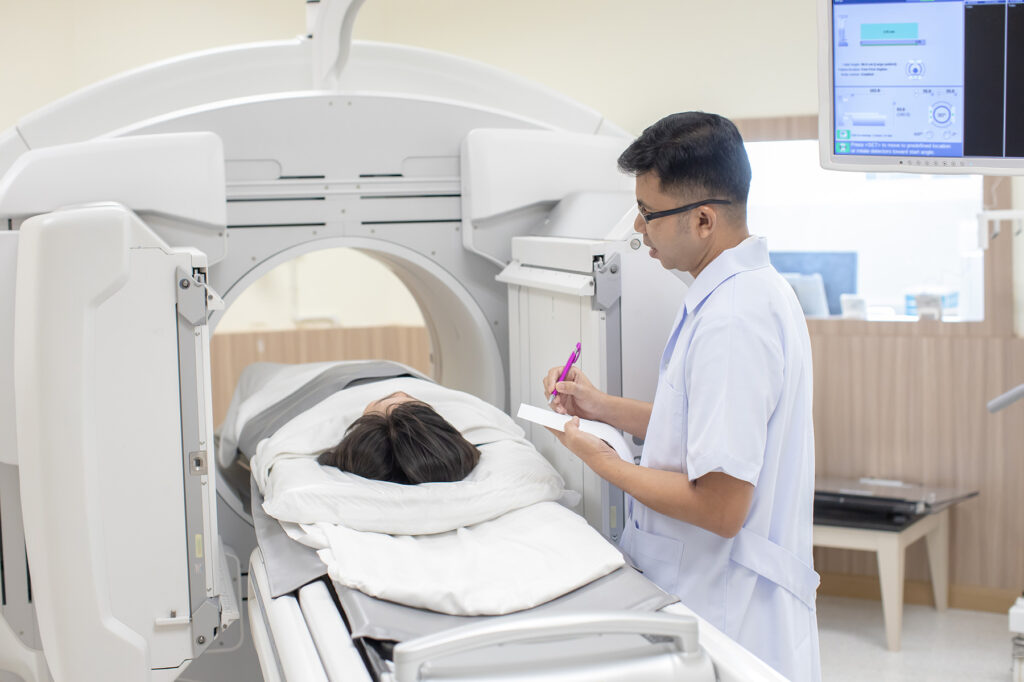
Nuclear Medicine Services available at PRP Clinics

Bone Scan
- Early detection and diagnosis of bone and joint abnormalities
- No preparation
- Two part test
Myocardial Perfusion Scan
- Identify areas of reduced blood flow in the heart
- Preparation Required
V/Q Lung Scan
- Assess and diagnose pulmonary embolism
- No preparation
- One part test
Biliary Scan
- Assessment of gallbladder ejection fraction
- Diagnose a bile duct obstruction
- Substantial meal required 6 hours prior to the scan
DTPA Renogram
- Test to assess relative renal function
- May need to fast prior
- The scan usually takes between 45-90 minutes
Gallium Scan
- Used to detect infection and inflammation in the body
- No preparation
Parathyroid Scan
- Identify a functioning parathyroid adenoma
- No iodine contrast 4 weeks prior
- Two part test
Thyroid Scan
- Assess overall thyroid function and detection of thyroid nodules
- No iodine contrast or medication for 4 weeks prior - Consult with your Doctor prior
- One part test
What You Need To Know About Nuclear Medicine Procedures

What is nuclear medicine?
When facing a health challenge, your doctor may refer you for a nuclear medicine scan. This type of test can help doctors evaluate how well your organs function or give them more information about how an injury or disease affects your body.
How does it work?
Nuclear medicine is a specific scanning process used to identify and sometimes treat diseases in their earliest stages, long before they appear on other tests.
Nuclear medicine utilises radioactive materials, called radiotracers or radiopharmaceuticals, usually injected into the body, to diagnose or treat disease. The radiopharmaceuticals may also be swallowed or inhaled, depending on the procedure.
The radiopharmaceuticals target specific organs, bones or tissues, emitting low-energy radiation as they travel through the body. This radiation is then detected by a special camera called a gamma camera.
Other types of scans, such as CT scans and X-rays, use external sources to generate radiation. Nuclear medicine scans are generated by detecting the radioactive pharmaceuticals distributed within the body.
What are the benefits?
Nuclear medicine is used by doctors to diagnose a broad range of medical conditions. It shows abnormalities in an organ, bone or tissue long before other diagnostic methods and it provides functional information that cannot usually be obtained using other imaging tests.
Nuclear Medicine scans are highly sensitive, which means that the scans are useful in finding subtle abnormalities that are often not visualised on other conventional imaging services.
Most nuclear medicine injections do not have any side effects or allergy risks, so they are safe alternative imaging tests for patients who are unable to undertake other imaging procedures.
How To Prepare For Your Nuclear Medicine Procedure
How to prepare for scanning?
If you have been referred by a Doctor for a Nuclear Medicine scan, understanding how to prepare for your scan is important.
When you make an appointment with PRP Diagnostic Imaging, the specific preparation for your scan will be explained to you in detail. Additionally, our friendly staff can answer any questions you may have about your test.
What are the risks involved?
Health risks associated with Nuclear Medicine procedures are considered very low. While nuclear medicine scans use some radiation, the amount used in the process is considered safe. Radiation exposure levels are about the same as for a CT scan.
The risk of an allergic reaction to Nuclear Medicine radiopharmaceuticals is very low and considered extremely rare. If you have any concerns, please ask one of our friendly staff members or consult your referring doctor.
What to do after the procedure?
The type of aftercare you require will depend on the type of procedure you’ve undertaken. However, there are some general guidelines to follow after nuclear medicine scans. All of these precautions will be explained to you prior to your scan, giving you the opportunity to ask any questions or raise any concerns with our staff.
- Stay hydrated to help flush the tracer injections from your body.
- Avoid close contact with pregnant women and young children immediately after your scans.
- Attend a follow-up appointment with your doctor to discuss the result of your scan.


What Our Patients Say About PRP
I would not go anywhere else for Diagnostic imaging. All staff from reception to radiographers are excellent, friendly and very caring. Thank you all for doing a wonderful job.
Commonly Asked Questions About Nuclear Medicine

Doctors refer their patients to PRP Diagnostic Imaging for a range of nuclear medicine scans, including:
- Bone Scan – can help to identify bony abnormalities.
- Myocardial Perfusion Scan – For coronary artery disease and coronary blockages.
- V/Q Scan - to diagnose blood clots in the lungs.
- Biliary Scan (HIDA Scan) – to assess gallbladder function.
- DTPA Renogram – to assess renal function and check for blockages.
- Gallium Scan – used to detect inflammation/infection in the body.
- Parathyroid Scan - for patients with primary hyperparathyroidism.
- Thyroid Scan - to evaluate thyroid function.
- White Blood Cell Scan - to find areas of inflammation and infection.
At PRP Diagnostic Imaging, we are able to bulk-bill some nuclear medicine scans at many of our clinics. However, we understand that navigating Medicare and out-of-pocket costs can be challenging, and we will inform you of any upfront expenses when you make an appointment.
Nuclear medicine tests are used by a range of medical disciplines to diagnose conditions such as:
- Heart disease, such as blocked arteries, due to coronary artery disease
- Cancer screening
- Neurological disorders, such as Alzheimer's disease
- The cause of bone and joint pain, such as bone fractures
- Hyperthyroidism, hypothyroidism and thyroid abnormalities
- To assess the function of organs, such as the lungs, kidneys, etc.